
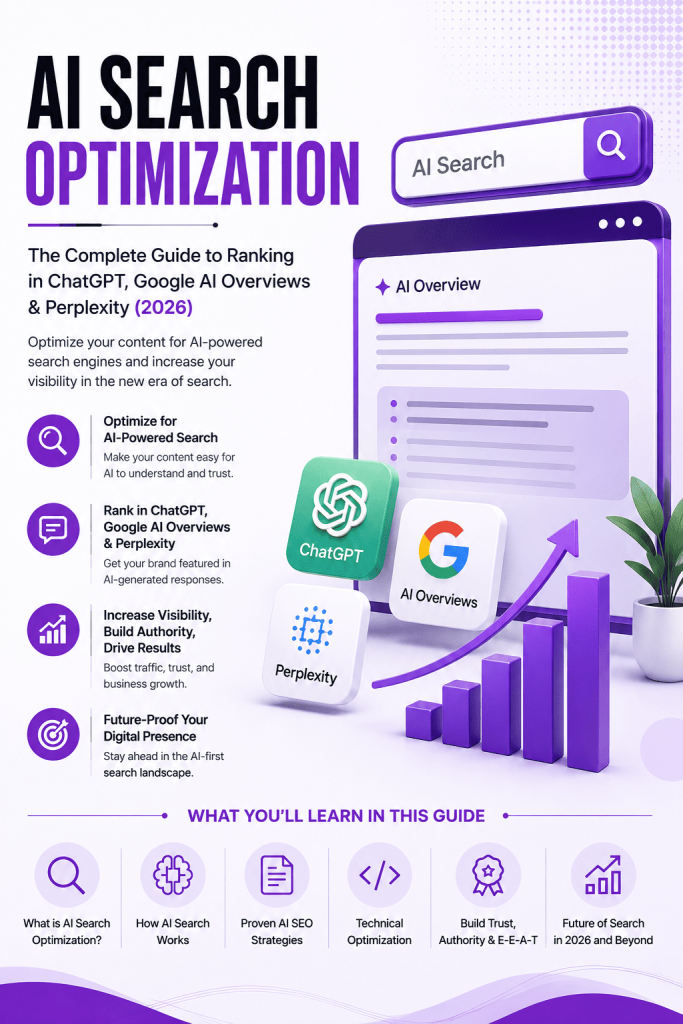
The way people search for information online has changed dramatically. Instead of scrolling through dozens of blue links, users now ask questions directly to AI tools like ChatGPT, Google AI Overviews, Perplexity AI, and Gemini. These AI platforms provide direct answers, reducing the need to visit multiple websites.
This shift means businesses must optimize not only for traditional search engines but also for AI-powered search experiences. This new strategy is known as AI Search Optimization.
If your business wants to remain visible in 2026 and beyond, understanding AI Search Optimization is no longer optional—it’s essential.
What Is AI search optimization?
AI Search Optimization is the process of making your website, content, and digital presence easier for artificial intelligence search engines to understand, trust, and reference when answering user questions.
Unlike traditional SEO, which focuses on improving rankings in search engine results pages (SERPs), AI Search Optimization aims to increase the chances of your content being selected as part of AI-generated responses.
The objective is not just to rank but to become a trusted source that AI platforms cite when generating answers.
Why AI Search Optimization Matters in 2026
Search behavior is evolving faster than ever. Millions of users now rely on AI assistants to answer questions instantly.
Here are a few reasons why AI Search Optimization has become crucial:
- AI-generated answers reduce traditional website clicks.
- Businesses that appear in AI responses build greater trust and authority.
- AI-powered search provides users with faster, conversational answers.
- Companies optimizing early gain a competitive advantage.
- AI search is becoming a standard feature across major search platforms.
Businesses that ignore AI Search Optimization risk losing visibility as search habits continue to evolve.
AI Search Optimization vs Traditional SEO
Although AI Search Optimization and SEO work together, they focus on different goals.
| Traditional SEO | AI Search Optimization |
|---|---|
| Improves Google rankings | Improves AI citations |
| Focuses on keywords | Focuses on answering questions |
| Optimizes search snippets | Optimizes conversational content |
| Builds backlinks | Builds authority and trust |
| Targets SERPs | Targets AI-generated responses |
The strongest digital marketing strategy combines both SEO and AI Search Optimization.
How AI Platforms Choose Content
AI tools evaluate much more than keywords. They prioritize content that demonstrates expertise, clarity, and trustworthiness.
Some important ranking factors include:
- Accurate and updated information
- Clear headings and structured content
- Strong topical authority
- High-quality backlinks
- Fast-loading websites
- Mobile-friendly design
- Schema markup
- Well-organized FAQs
- Helpful, human-first content
The better your website communicates information, the easier it becomes for AI systems to understand and recommend it.
10 Proven AI Search Optimization Strategies
1. Write Content That Answers Questions
Instead of writing around keywords alone, create content that directly answers user questions.
For example:
- What is AI Search Optimization?
- How does ChatGPT choose websites?
- Can AI replace SEO?
- How do Google AI Overviews work?
Question-based content aligns perfectly with AI search behavior.
2. Build Topical Authority
Publishing one article isn’t enough.
Create multiple in-depth articles covering every aspect of your niche.
For example, if your business focuses on digital marketing, write about:
- SEO
- Local SEO
- Technical SEO
- AI Search Optimization
- Google AI Overview
- ChatGPT SEO
- GEO
- AEO
- Content Marketing
This helps AI recognize your website as an authoritative source.
3. Optimize for E-E-A-T
Google and AI platforms value Experience, Expertise, Authoritativeness, and Trustworthiness.
Improve E-E-A-T by:
- Adding author bios
- Sharing real case studies
- Citing reliable sources
- Publishing original insights
- Keeping content updated
Trust is one of the strongest ranking signals in AI search.
4. Use Structured Headings
Organize your content with clear H2 and H3 headings.
Example:
H2: What Is AI Search Optimization?
H2: Benefits of AI Search Optimization
H2: Best AI SEO Practices
Clear content structure improves readability for both users and AI systems.
5. Add FAQ Sections
Frequently Asked Questions provide concise answers that AI platforms can easily understand and reference.
Example questions:
- What is AI Search Optimization?
- Does ChatGPT rank websites?
- What is GEO?
- How do AI search engines work?
6. Implement Schema Markup
Schema helps search engines understand your content.
Important schema types include:
- Article
- FAQ
- Organization
- Breadcrumb
- Local Business
- Person
Structured data increases your chances of appearing in rich results and AI-generated answers.
7. Improve Website Speed
Fast websites offer better user experiences.
Optimize:
- Core Web Vitals
- Image compression
- Browser caching
- Lazy loading
- Clean code
Speed remains a key ranking factor for both SEO and AI visibility.
8. Publish Original Research
AI systems value unique information.
Consider publishing:
- Industry surveys
- Marketing reports
- Case studies
- Original data
- Customer success stories
Unique content is more likely to be cited than generic articles.
9. Keep Content Fresh
AI platforms favor updated information.
Review and refresh older articles regularly by:
- Updating statistics
- Adding new examples
- Improving headings
- Expanding explanations
- Removing outdated information
10. Focus on User Intent
Every article should solve a specific problem.
Ask yourself:
- What question is the reader trying to answer?
- What action should they take next?
Helpful content consistently performs better than keyword-stuffed articles.
Common AI Search Optimization Mistakes
Avoid these common errors:
- Publishing thin content
- Ignoring search intent
- Using excessive AI-generated text without editing
- Not updating old articles
- Poor website structure
- Missing schema markup
- Slow-loading pages
- Weak internal linking
Fixing these issues improves both SEO and AI visibility.
AI Search Optimization Checklist
Use this checklist before publishing any article:
✔ Include the focus keyword naturally.
✔ Write helpful, original content.
✔ Use clear H2 and H3 headings.
✔ Add FAQ sections.
✔ Optimize images.
✔ Implement schema markup.
✔ Improve page speed.
✔ Add internal links.
✔ Include external authoritative references.
✔ Update content regularly.
The Future of AI Search
AI-powered search is transforming digital marketing.
Instead of simply ranking on Google, businesses must now earn visibility within AI-generated answers.
Brands that publish trustworthy, well-structured, and experience-driven content will be more likely to appear in ChatGPT, Google AI Overviews, Gemini, Perplexity, and future AI search platforms.
The future belongs to businesses that adapt early.
Conclusion
AI Search Optimization is rapidly becoming an essential part of every successful digital marketing strategy. While traditional SEO remains important, optimizing for AI search ensures your content is ready for the next generation of search experiences.
By creating high-quality content, demonstrating expertise, implementing structured data, and focusing on user intent, your business can improve its chances of being recommended by AI-powered search engines.
If you’re ready to future-proof your online presence, start implementing AI Search Optimization today.
Frequently Asked Questions
What is AI Search Optimization?
AI Search Optimization is the process of optimizing your website and content so AI-powered search platforms like ChatGPT, Google AI Overviews, Gemini, and Perplexity can understand, trust, and recommend your content.
Is AI Search Optimization replacing SEO?
No. AI Search Optimization complements traditional SEO. Businesses should combine both strategies for maximum online visibility.
How can I improve my AI Search Optimization?
Create original content, answer user questions clearly, use schema markup, improve website speed, build topical authority, and keep your content updated regularly.
Which AI platforms should businesses optimize for?
Businesses should optimize for ChatGPT, Google AI Overviews, Gemini, Perplexity AI, and other emerging AI-powered search platforms.
Why is AI Search Optimization important for small businesses?
It helps small businesses gain visibility in AI-generated answers, build trust with potential customers, and stay competitive as search behavior evolves.