
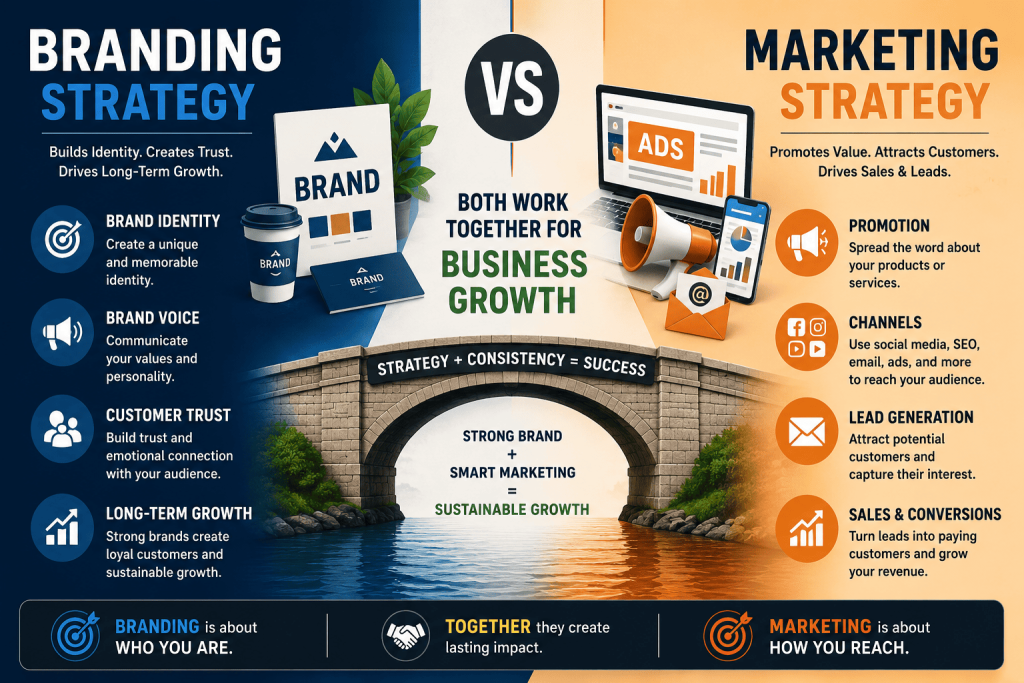
In today’s competitive marketplace, businesses often confuse a branding strategy with a marketing strategy. While both are essential for growth, they serve different purposes. A well-defined strategy helps businesses establish a unique identity, while a marketing strategy focuses on promoting products and services to attract customers.
Understanding the difference between these two concepts can help businesses create stronger customer relationships, improve brand recognition, and achieve long-term success.
What Is a Branding Strategy?
A strategy is a long-term plan that defines how a company wants to be perceived by its target audience. It encompasses everything from brand values and messaging to visual identity and customer experience.
The key elements of a branding strategy include:
- Brand mission and vision
- Brand values
- Target audience
- Brand positioning
- Brand voice and tone
- Visual identity (logo, colors, and typography)
Benefits
- Increase brand recognition
- Build customer trust
- Improve customer loyalty
- Differentiate your business from competitors
- Support long-term business growth
What Is a Marketing Strategy?
A marketing strategy is a plan designed to promote products or services and generate leads, sales, or conversions.
Marketing activities typically include:
- Search Engine Optimization (SEO)
- Content marketing
- Social media marketing
- Email marketing
- Pay-per-click advertising
- Influencer marketing
Branding vs Marketing Strategy: Key Differences
Although they work together, branding and marketing have distinct roles.
1. Purpose
Branding : Defines who your business is.
Marketing: Promotes what your business offers.
2. Focus
Branding : Builds trust, reputation, and emotional connections.
Marketing : Generates awareness, leads, and sales.
3. Timeframe
Branding: Long-term approach.
Marketing : Can include both short-term and long-term campaigns.
4. Goal
Branding : Creates customer loyalty and brand equity.
Marketing: Drives customer acquisition and revenue growth.
Why Branding Comes First
Many businesses focus heavily on marketing without developing a strong branding strategy. This can result in inconsistent messaging and weaker customer relationships.
Before launching marketing campaigns, businesses should establish:
- Clear brand values
- Unique brand positioning
- Consistent messaging
- Defined target audience
- Strong visual identity
A solid branding strategy provides the foundation that makes every marketing effort more effective.
How Both Strategy Work Together?
The most successful businesses align their branding and marketing efforts.
For example:
- Branding defines the message.
- Marketing delivers the message.
- Branding creates trust.
- Marketing creates visibility.
- Branding builds loyalty.
- Marketing generates leads.
When both strategies are aligned, businesses create a consistent customer experience that drives sustainable growth.
Common Mistakes Businesses Make
Ignoring Branding
Many companies invest in advertising before developing a branding , leading to poor differentiation.
Inconsistent Messaging
A lack of consistency across websites, social media, and advertising can confuse customers.
Focusing Only on Short-Term Results
Marketing can generate immediate sales, but a strong branding strategy creates long-term business value.
Not Understanding the Target Audience
Both branding and marketing should be built around customer needs and preferences.
How to Build an Effective Strategy
Follow these steps
Define Your Brand Purpose
Clearly communicate why your business exists beyond making a profit.
Understand Your Audience
Research customer needs, challenges, and expectations.
Develop a Unique Positioning Statement
Identify what makes your brand different from competitors.
Create Consistent Brand Messaging
Maintain the same voice and tone across all communication channels.
Design a Strong Visual Identity
Ensure your logo, colors, and design elements reflect your brand personality.
Conclusion
Understanding the difference between a branding strategy and a marketing strategy is essential for business success. While marketing helps attract customers, a branding strategy builds trust, loyalty, and long-term recognition.
Businesses that invest in a strong branding strategy before launching marketing campaigns are better positioned to stand out in competitive markets. By aligning branding and marketing efforts, companies can create meaningful customer relationships and achieve sustainable growth.
Frequently Asked Questions
What is the difference between branding strategy and marketing strategy?
A branding strategy focuses on building a brand’s identity and reputation, while a marketing strategy focuses on promoting products or services to generate sales and leads.
Why is a branding strategy important?
A branding strategy helps businesses build trust, improve recognition, differentiate themselves from competitors, and create long-term customer loyalty.
Can a business succeed without a branding strategy?
While a business may generate short-term sales through marketing, long-term growth is difficult without a clear branding strategy that establishes trust and recognition.
Which comes first: branding strategy or marketing strategy?
A branding strategy should come first because it provides the foundation for all marketing activities and ensures consistent messaging.